Table of Contents
- Introduction: Why Financial Health Matters Daily
- 1. Track Every Expense — Awareness is Power
- 2. Follow the 50/30/20 Rule Automatically
- 3. Build a “No-Spend” Mindset for 10 Minutes a Day
- 4. Review Your Financial Dashboard Every Morning
- 5. Learn Something About Money Every Day
- 6. Automate Your Savings & Bill Payments
- 7. Practice Gratitude & Reflect on Financial Wins
- Free Tools to Support Your Daily Financial Habits
- Building Long-Term Financial Discipline
- Conclusion
- FAQs
💡 Introduction: Why Financial Health Matters Daily
Most people think improving financial health means earning more.
In reality, it’s what you do daily — not monthly — that defines your wealth trajectory.
According to Forbes, over 68% of financially successful individuals credit their wealth to consistent habits, not sudden income boosts.
Financial health is like physical fitness: if you eat junk once a week, you recover; but if you do it daily, the damage compounds. The same goes for money.
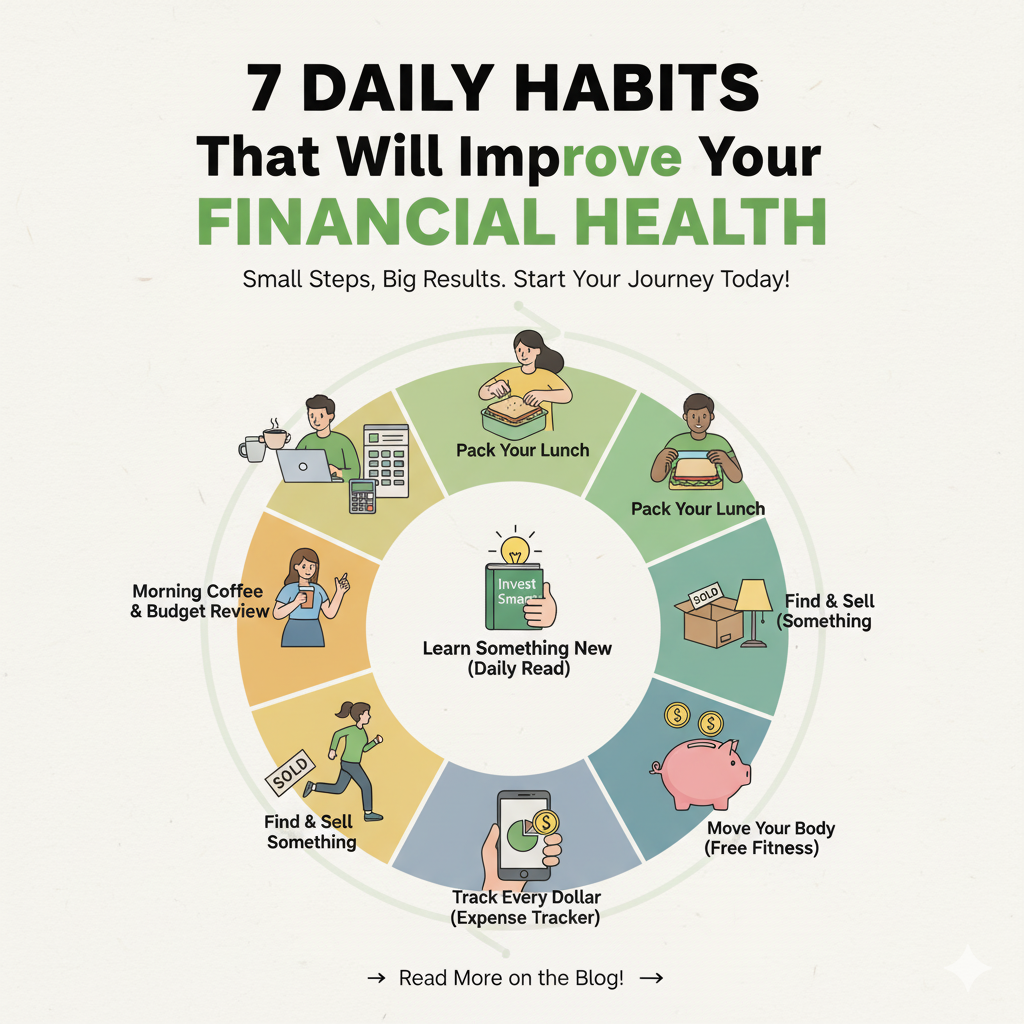
In this guide, you’ll learn 7 simple but powerful daily habits that will strengthen your financial health — without requiring fancy tools or expensive courses. Each habit is backed by experience, expert advice, and free strategies anyone can start today.
💰 1. Track Every Expense — Awareness is Power
“You can’t improve what you don’t measure.” — Brian Dean, Backlinko
Every strong financial foundation starts with awareness.
Tracking your daily expenses helps you understand exactly where your money goes — and how to redirect it towards your goals.
✅ How to Start:
- Record every transaction — no matter how small.
- Use free tools like Google Sheets, Mint, or Money Manager app.
- At day’s end, review: “Did I spend according to my priorities?”
💡 Expert Insight:
According to NerdWallet, people who track expenses daily save at least 20% more per month than those who don’t.
🔗 Internal Link Suggestion:
👉 Link to: “How to Track Expenses Automatically Using Google Sheets”
📊 2. Follow the 50/30/20 Rule Automatically
The 50/30/20 budgeting rule (popularized by Elizabeth Warren) is one of the simplest and most effective frameworks to balance spending and saving.
🧮 The Formula:
- 50% → Needs (rent, bills, groceries)
- 30% → Wants (entertainment, hobbies)
- 20% → Savings & debt payments
🔁 Daily Habit:
- Review your digital wallet each night.
- Ask yourself: “Did my spending align with the 50/30/20 balance today?”
You can even use budget automation tools like YNAB or Revolut that categorize transactions automatically.
📈 Pro Tip:
Turn your budgeting into a morning ritual — just 3 minutes to glance at your spending keeps you financially conscious all day.
🧠 3. Build a “No-Spend” Mindset for 10 Minutes a Day
The “no-spend” habit isn’t about deprivation — it’s about delayed gratification and self-control.
A Harvard Business Review study found that practicing short periods of “mindful restraint” rewires your brain to enjoy saving instead of spending.
💪 Try This:
- Choose one “no-spend” item daily — coffee, snacks, or impulse buys.
- Instead, move that amount to your “Freedom Fund” (a savings account for goals).
- Track how much you’ve “earned” by not spending.
🎯 Result:
After 30 days, you’ll build psychological resistance to unnecessary expenses — and you’ll see a tangible savings difference.
📅 4. Review Your Financial Dashboard Every Morning
Just as athletes check their vitals, financially healthy people check their money metrics daily.
Create your own financial dashboard — a simple one-page sheet showing:
- Current bank balance
- Upcoming bills
- Investment growth
- Debt reduction progress
🔍 Tools:
- Google Sheets dashboard with graphs
- Mint / PocketGuard overview
- Or simply a manual journal
This 2-minute review triggers your reticular activating system — your brain’s focus filter — to stay aligned with your financial goals all day.
📚 5. Learn Something About Money Every Day
Financial literacy compounds like interest.
Spending just 10 minutes daily learning about money gives you an unbeatable long-term edge.
🧠 Daily Learning Routine:
- Read 1 blog post on Backlinko or NerdWallet
- Watch a 5-minute video from Graham Stephan or The Plain Bagel
- Explore one personal finance subreddit thread
Over a year, that’s 60 hours of education — enough to outperform 80% of people in financial decision-making.
🔗 Internal Link Suggestion:
👉 Link to: “Top 10 Free Websites to Learn Personal Finance”
⚙️ 6. Automate Your Savings & Bill Payments
Automation is the ultimate financial superpower.
According to MonsterInsights, automation improves consistency and eliminates emotional decision-making.
💸 Daily Habit Setup:
- Set recurring transfers to your savings account.
- Automate recurring bills through your bank app.
- Use Google Calendar reminders for manual payments.
⚡ Why It Works:
When savings happen before spending, you follow the “Pay Yourself First” rule — one of the oldest and most effective wealth-building principles.
Automation isn’t laziness — it’s strategic discipline.
❤️ 7. Practice Gratitude & Reflect on Financial Wins
Financial health isn’t only numbers — it’s mindset.
Practicing daily gratitude reduces financial anxiety and promotes abundance thinking — the belief that money is a renewable resource, not a constant stressor.
🌿 Try This:
- End your day listing 3 money-related wins (e.g., “Skipped fast food,” “Saved $10,” “Paid bill on time”).
- Track them in a simple Google Doc.
Research from Psychology Today shows that gratitude journaling improves long-term money satisfaction by up to 25%.
🧭 The Bigger Picture:
When you focus on progress, not perfection, you stay motivated — and motivation compounds faster than interest.
🧰 Free Tools to Support Your Daily Financial Habits
Here are 100% free tools to help you maintain daily financial discipline:
| Purpose | Tool | Why It Helps |
|---|---|---|
| Expense Tracking | Google Sheets / Mint | Simple and flexible for daily tracking |
| Budget Planning | YNAB (Free Trial) | Automates 50/30/20 budgeting |
| Learning | Investopedia / NerdWallet | Daily finance insights |
| Automation | Revolut / Payoneer | Automatic transfers and bill payments |
| Reflection | Google Keep / Notion | Track gratitude and daily goals |
🏆 Building Long-Term Financial Discipline
Daily habits build identity.
As James Clear, author of Atomic Habits, writes:
“Every action you take is a vote for the person you want to become.”
By repeating these micro-habits, you shift your identity from spender to wealth builder.
🔄 Weekly Reflection:
- Which habit felt easiest?
- Which drained your motivation?
- What’s one small upgrade you can make next week?
Tiny improvements multiply into massive results — just like compound interest.
🔚 Conclusion
Improving your financial health doesn’t require a windfall — it requires consistency.
By applying these 7 daily habits, you’ll:
- Gain full control over your spending
- Save more effortlessly
- Strengthen your mindset toward wealth
Start with one habit today. Within 30 days, you’ll notice measurable improvement in your financial clarity, confidence, and stability.
“Financial freedom is not about luck — it’s about daily behavior.”
— Nehaw Finance
❓FAQs: People Also Ask
Q1. What is the fastest way to improve financial health?
Start tracking your spending daily and automate savings. Awareness + automation create instant clarity.
Q2. How long does it take to build strong financial habits?
On average, it takes 21–30 days of consistency for habits to stick. Focus on one new habit per week.
Q3. Can free tools really improve financial management?
Yes. Free tools like Google Sheets, Mint, and YNAB’s trial offer everything needed for effective money tracking.
Q4. What’s the best first step for beginners?
Begin with expense tracking. Once you understand your cash flow, budgeting and saving become easy.
Q5. How do I stay motivated with money habits?
Celebrate small wins, journal progress, and remind yourself that consistency beats intensit


One thought on “7 Daily Habits That Will Improve Your Financial Health”