Table of Contents
- Introduction: Why ETFs Matter in 2025
- What Is an ETF?
- How ETFs Work (Simple Breakdown)
- ETFs vs Mutual Funds vs Stocks
- Why ETFs Are Perfect for Beginners
- Types of ETFs You Should Know
- How to Start Investing in ETFs (Step-by-Step)
- Best ETF Strategies for Long-Term Investors
- Top Free Tools to Research ETFs
- Risks of ETF Investing (and How to Manage Them)
- Expert Tips: Building a Smart ETF Portfolio
- Conclusion: Smarter Investing Starts Simple
- FAQs
Introduction: Why ETFs Matter in 2025
If you’ve ever wondered how investors grow their wealth without spending hours trading stocks, ETFs (Exchange-Traded Funds) might be the answer.
In 2025, ETFs have become the go-to choice for beginner and professional investors alike, offering diversification, low costs, and flexibility—all in one investment vehicle.
Whether you’re just starting out with $100 or refining your long-term strategy, understanding ETFs can make your investing journey smarter and less stressful.
What Is an ETF?
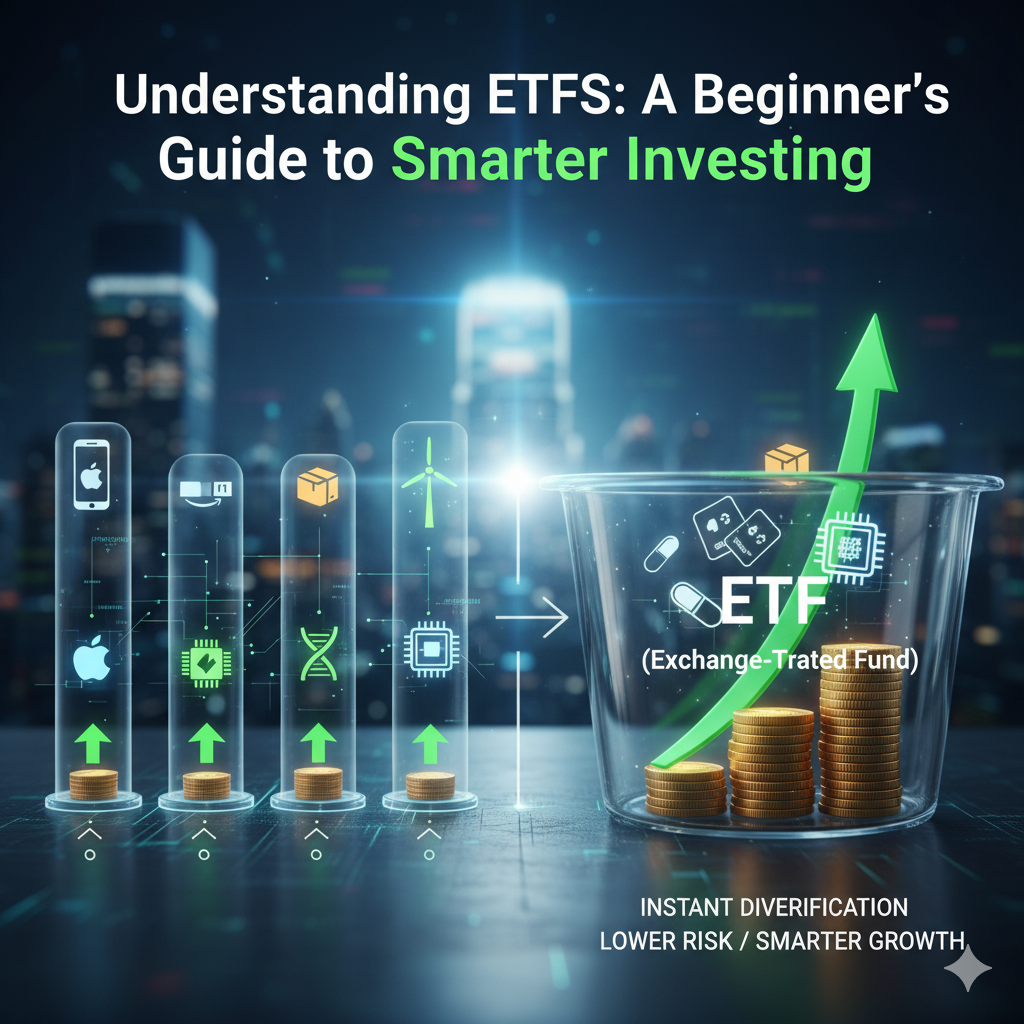
An ETF (Exchange-Traded Fund) is a basket of assets—like stocks, bonds, or commodities—that you can buy or sell on the stock market just like a regular stock.
Think of it like a shopping cart filled with mini pieces of dozens (sometimes hundreds) of companies. When you buy one share of an ETF, you’re investing in all those companies at once.
This diversification reduces your risk compared to owning a single stock.
Example:
If you invest in the S&P 500 ETF (like SPY or VOO), you’re buying into the 500 largest U.S. companies—spreading your risk across giants like Apple, Microsoft, and Amazon.
How ETFs Work (Simple Breakdown)
Here’s a simple breakdown of how ETFs function:
- ETF Provider Creates the Fund:
Companies like Vanguard, BlackRock (iShares), or Schwab design ETFs that track specific indexes or sectors. - ETF Tracks an Index or Theme:
For example, an ETF might track the NASDAQ 100, renewable energy sector, or emerging markets. - You Buy Shares of the ETF:
You can buy ETF shares through any brokerage—just like buying a stock. - ETF Price Fluctuates:
The price moves throughout the day based on the value of its underlying assets.
In short: ETFs are passive, diversified, and transparent investments that make it easier for everyday investors to build wealth.
ETFs vs Mutual Funds vs Stocks
| Feature | ETFs | Mutual Funds | Individual Stocks |
|---|---|---|---|
| Trading | Trades like a stock | Priced once per day | Trades like a stock |
| Fees | Very low (0.03–0.5%) | Often higher (1–2%) | No management fee |
| Diversification | High | High | Low |
| Minimum Investment | 1 share (low) | Often $500+ | 1 share |
| Liquidity | High | Medium | High |
Bottom line: ETFs combine the best of both worlds — the diversification of mutual funds and the flexibility of individual stocks.
Why ETFs Are Perfect for Beginners
ETFs are ideal for beginners because they:
- Require little knowledge of the market.
- Offer instant diversification.
- Are low-cost and transparent.
- Can be bought with as little as $50–$100 using fractional shares.
- Don’t require constant monitoring.
In 2025, many free investing apps like Fidelity, Charles Schwab, and Robinhood allow investors to start ETF investing without paying commissions.
Types of ETFs You Should Know
Here are the main types of ETFs worth knowing about:
1. Index ETFs
Track major market indexes like the S&P 500 (VOO) or NASDAQ 100 (QQQ).
Best for: Long-term passive investors.
2. Bond ETFs
Hold government or corporate bonds for stable returns.
Best for: Risk-averse investors or those near retirement.
3. Sector ETFs
Focus on specific industries (e.g., tech, healthcare, energy).
Best for: Investors who want exposure to growing sectors.
4. Dividend ETFs
Include companies that pay consistent dividends (e.g., VYM, SCHD).
Best for: Income-focused investors.
5. Thematic or ESG ETFs
Follow emerging themes like clean energy, AI, or sustainability.
Best for: Forward-thinking investors who believe in innovation.
How to Start Investing in ETFs (Step-by-Step)
Here’s a simple roadmap to start investing in ETFs—even if you’re a complete beginner.
Step 1: Define Your Financial Goals
Ask yourself:
- Are you investing for retirement, wealth growth, or passive income?
- What’s your risk tolerance?
Your answers will determine what kind of ETFs fit your portfolio.
Step 2: Choose a Trusted Brokerage
Look for:
- Zero commission fees
- Fractional share investing
- Automatic reinvestment (DRIP)
Examples: Fidelity, Vanguard, Charles Schwab, Robinhood, eToro.
Step 3: Select ETFs Aligned With Your Goals
For example:
- Long-term growth → S&P 500 ETF (VOO)
- Income → Dividend ETF (SCHD)
- Low risk → Bond ETF (BND)
Step 4: Start Small, Stay Consistent
Start with as little as $50–$100.
Use a dollar-cost averaging strategy: invest a fixed amount every month regardless of price changes.
Step 5: Track and Rebalance
Use free tools like:
- Google Sheets (portfolio tracking)
- Yahoo Finance
- Morningstar ETF Screener
- Google Trends (for market sentiment)
Best ETF Strategies for Long-Term Investors
1. Buy and Hold
The simplest and most powerful approach.
Pick a few high-quality ETFs and hold them for 5–10+ years.
2. Core-Satellite Strategy
Build a “core” portfolio with broad ETFs (like VTI or VOO), then add smaller “satellite” ETFs for specific themes like AI or green energy.
3. Dividend Reinvestment Strategy
Use ETFs that pay dividends and automatically reinvest them through your brokerage’s DRIP feature.
4. Global Diversification
Combine U.S. ETFs with international or emerging market ETFs to reduce country-specific risk.
Top Free Tools to Research ETFs
Use these no-cost tools to make smarter ETF decisions:
| Tool | Best For | Website |
|---|---|---|
| Morningstar | Detailed ETF analysis | morningstar.com |
| Google Finance | Quick ETF lookups | google.com/finance |
| Ubersuggest | Keyword research for finance blogs | neilpatel.com/ubersuggest |
| ETF.com | Fund comparisons | etf.com |
Risks of ETF Investing (and How to Manage Them)
While ETFs are safer than individual stocks, they’re not risk-free.
Main Risks:
- Market Risk: ETFs can lose value if the market drops.
- Tracking Error: Sometimes ETFs don’t perfectly match their underlying index.
- Liquidity Risk: Rare ETFs may have low trading volume.
- Over-Diversification: Too many ETFs can reduce returns.
Risk Management Tips:
- Stick to large, liquid ETFs (like VOO or QQQ).
- Rebalance your portfolio annually.
- Avoid chasing hype-driven thematic ETFs.
- Keep an emergency fund separate from investments.
Expert Tips: Building a Smart ETF Portfolio
- Start broad, then specialize.
Begin with index ETFs before moving to niche sectors. - Automate your investing.
Use recurring deposits or robo-advisors to stay consistent. - Monitor fees.
Choose ETFs with expense ratios below 0.2% when possible. - Stay long-term focused.
As Warren Buffett says, “The stock market is a device for transferring money from the impatient to the patient.” - Keep learning.
Follow trusted sources like Backlinko (for content SEO on investing blogs), Morningstar, and Investopedia for updates.
Conclusion: Smarter Investing Starts Simple
ETFs are one of the smartest, safest, and most flexible investment tools available in 2025.
They allow beginners to diversify instantly, minimize risk, and grow wealth steadily — without needing to pick individual stocks.
Start small, stay consistent, and let time and compounding do their magic.
If you’re new to investing, ETFs are your gateway to financial freedom.
FAQs
1. Are ETFs good for beginners?
Yes! ETFs are perfect for beginners because they offer diversification, low fees, and easy access through most brokerages.
2. How much money do I need to start investing in ETFs?
You can start with as little as $50–$100, especially with fractional share investing.
3. What is the safest ETF to invest in?
Broad-market ETFs like Vanguard Total Stock Market (VTI) or S&P 500 ETF (VOO) are considered relatively safe.
4. Are ETFs better than mutual funds?
Yes, in most cases. ETFs are cheaper, more flexible, and easier to trade than mutual funds.
5. Can I lose money in ETFs?
Yes, like all investments, ETFs can decline in value during market downturns. However, diversified ETFs reduce individual company risk.